Showing posts with label 19th century architecture. Show all posts

Saturday, 8 February 2014

Random Reasons to Love London #12


Today I had to trot up to the British Library to buy a present from the shop there (which, incidentally, has a really great selection of books and gifts, if you're ever looking for something for a discerning book lover). Deciding to get a coffee after having accomplished my mission, I stopped into St Pancras Station, which is, in my opinion, one of London's great public spaces. There's something lovely and exciting about railway travel, and this just imbues the place...


Seeing people tinkering on the two pianos there also always makes me smile, especially when you get a total juxtaposition between the players on each one. Today, there was a professional busker on one piano, accompanied by a woman on a French horn... and they seemed largely unperturbed when a slightly strange bearded man came along and leaned on the piano, intermittently tinkling a few keys at his end. At the other piano there was a small child having a go, later replaced by the couple above. I've seen all sorts playing there and I love the variety of people it attracts.

When I eventually emerged from the station, I was faced with a passing shower, resulting in a rainbow over King's Cross Station (which, between you and me, I prefer to St Pancras, architecturally, but that's a subject for another post).


It was a crazy day for weather generally, with gusty winds and frequent changes from sun and blue skies to rain and dark clouds. It somewhat messed with my original plans for the day, which entailed a bicycle, but it didn't work out at all badly, ultimately.


Saturday, 30 November 2013

Let Glasgow Flourish (Love Letter from Glasgow)

The Cenotaph and City Chambers on George Square

I was all set to write a post about Glasgow today, it being St Andrew's Day, and because I recently made a trip there on a day when it was graced with blue skies and I was able to get some half-decent photos of its astonishingly beautiful architecture. Time wasn't on my side as I was there for work and had other things to be getting on with, but I was able to nevertheless grab a few shots around the centre of the city.

However, I find myself writing now with some sadness, as I woke to hear about a terrible accident last night in which a helicopter crashed into a pub by the Clyde. There have been several confirmed fatalities and series injuries, and rescue work is ongoing as I write this. My thoughts and prayers go out to the people directly and indirectly affected by this shocking event, in that city for which I feel great fondness.

I fell in love with Glasgow quickly when I first visited it ten years ago on a short, solo Scottish trip. I started with a few days in Edinburgh and then headed to Glasgow, via Stirling. Edinburgh impressed me undoubtedly, especially the unforgettable experience of coming out of the train station and seeing the Castle hanging off a towering, dramatic rock, right in the heart of the city. But there was something about Glasgow that spoke to me more than did Edinburgh. I struggled to put my finger on it, but I just felt more at home there. The atmosphere felt more vibrantly urban and exciting, and it was arguably more visually compelling than its typically more admired cousin. I was enamoured of its strikingly noble but slightly decaying buildings. I remember taking a photograph of rusty ironwork on a bridge near Glasgow Green, on my way to the People's Palace, revelling in its rustic, gritty. poignant beauty, and contemplating whether I would have been quite so drawn to it, were it in pristine condition. I would share the photo with you now but it is somewhere stashed in a storage cupboard in my family home so I don't have it to hand...

Ironwork in the city centre, more cared for, but just as beautiful, as that which captured
my fancy on my first Glaswegian trip

Instead, I will share some more recent photos of this beautiful city, known as the 'Second City of the Empire' in the nineteenth century and which, in my humble opinion, is still one of the best in the UK. I hope to one day have the honour to live there, even if just temporarily... And even if I will have to re-name my blog. Love Letter from Glasgow? Doesn't have the quite same as Love Letter from London but we can work on that.


Having been back a few times in recent years, one of the things that particularly thrills me about Glasgow is the fantastic eclecticism of its buildings. So many periods and styles of the highest quality are represented in this richly varied city. I also love that it is not stuck visually or psychologically in one past moment in time, but continues to morph and develop and change, as any true city should. Sure, it's not always quite so pretty, and mistakes have been made, but Glasgow's energy has been kept alive through all these changes. I have to confess that I even get a buzz crossing over the roaring M8 (which circles the city in a choking ring and was almost certainly responsible for some criminal demolitions of old architectural gems...); I love seeing the view out to the council estate blocks sticking up out of the urban fabric. And I do admit that such a statement has the aura of someone giddily in love, akin to perceiving someone's nasty habits as endearing. Of course Glasgow must have shortcomings but I'm quite blind to them, or willing to shrug them off in my current state of infatuation. 


Although I do have to say that I worry for it sometimes. Beautiful, historic buildings not at all far from the centre of the city are left to flounder, empty and unloved. Meanwhile, I worry about the risk of unthinking, ill-considered new development gradually eroding the character of the heart of the city. By all means, Glasgow, continue to morph and develop and change - it's one of the reasons I love you, after all - but please pay heed to the joyousness and creativeness of your rich architectural legacy as you do so. Modern architecture has the potential to enrich and add to the exciting patchwork of your urban fabric but just please take care... That's the challenge facing Glasgow but it's met it in the past so can surely continue to do so into the future. So as the city's motto says, let Glasgow flourish!


Anyway, I hope that these pictures capture at least some of the beauty of Glasgow's built environment. It is a city which I find difficult to do credit to with photographs, because it is the variety and juxtaposition which makes it so special. It's the uplifting and ever changing views which you get along its hilly streets, the shifting depth and range that the human eye can appreciate but which cannot be captured by a restrictive camera's field of vision. Still, I did what I could...


Friday, 4 October 2013

A Hidden Street Off Piccadilly

Albany's Ropewalk in 1903 - London' s most secret and most fabulous street (Image source)

Algernon:  Your name isn’t Jack at all; it is Ernest.
Jack:          It isn’t Ernest; it’s Jack.
Algernon: You have always told me it was Ernest. I have introduced you to everyone as Ernest. You answer to the name of Ernest. You look as if your name was Ernest. You are the most earnest-looking person I ever saw in my life. It is perfectly absurd your saying that your name isn’t Ernest. It’s on your cards. Here is one of them: (Reading: ) ‘Mr Ernest Worthing, B4, The Albany, W.’


So runs an exchange from Oscar Wilde's classic play, The Importance of Being Earnest. But what is this address, The Albany, of which they speak? Well, it was in Wilde's day, and remains today, just possibly the finest address in London, located right off Piccadilly:


Oh wait, you don't see it marked on the standard street map? That's because it's utterly exclusive. I assure you it exists but you can't always rely on maps: you just need to know it's there. Look again, at this proper old map. It's right there between Sackville Street and Burlington House (or the Royal Academy):

1851 map of London, showing Albany nestled in between Piccadilly, Regent Street and Burlington House

The Albany - or Albany, depending on when you are speaking and how fashionable you are (now, at the beginning of the 21st century, 'Albany', without the definitive article, is de rigeur) - is a series of gentlemen's apartments opening off a private, covered street right in the heart of Mayfair. Albany was created in 1802-03 by the architect Henry Holland, who also built Carlton House, a ridiculously exuberant mansion for the decadent Prince Regent (now sadly demolished). To access the flats (or 'sets', as they are correctly known) of Albany, one passes through what was once Melbourne House, built by the architect Sir William Chambers in 1771-74. Holland also converted this into sets as part of his overall scheme for what is quite possibly the earliest ever example of, let's admit it, bachelor pads - albeit it very, very classy ones.

c.1830 etching of Albany Courtyard by John Shepherd (Image source

Last week, my colleagues and I were granted exclusive access to Albany. We got to stroll in a leisurely fashion down the Ropewalk (as the covered street is known), stop in the tranquil gardens and enjoy a drink with one of the residents in his beautifully proportioned, comfortably sized, perfectly maintained set... Is it a little bit obvious to say that I could definitely live there? Oh, and women are allowed to these days, for the record. Although, I have to confess that the traditionalist/misogynist in me does kind of prefer the idea of some of my more stylish male friends living there to me personally doing so... But the other part of me says 'screw tradition - give me a set!'

A fine example of a room in one of the sets (Image source)

As you may well imagine, all sorts of fabulous and famous people have lived at this fabulous and famous address, from poet, Lord Byron, to author, Aldous Huxley, from architect of the British Museum, Robert Smirke, to prime minister, William Gladstone. As a self-confessed Oscar Wilde groupie, however, it is still the fact that Albany appears in Earnest that tickles my fancy most. And so, it was with great pleasure that a very dear friend of mine (the perfect Algy) and myself (a questionable Jack) regaled our gathered workmates with a reading from the play at twilight in the garden of the one and only Albany, concluding with the following confession:

Jack:         When one is placed in the position of guardian one has to adopt a very high moral tone on all subjects. It’s one's duty to do so. And as a high moral tone can hardly be said to conduce very much to either one’s health or one’s happiness if carried to excess, in order to get up to town I have always pretended to have a younger brother of the name of Ernest, who lives in the Albany, and gets into the most dreadful scrapes. 

Our host and the porter were much amused and invited us back for another recital some other time. I do hope that they meant it...

Our stage: one of the gardens at Albany (Image source)


Saturday, 27 April 2013

Random Reasons to Love London #9

Recently, I was walking back to my office after an exclusive look into one of Piccadilly's lesser known but absolutely fabulous and unique buildings (one reason to love London). I decided to stop off and eat my lunch in the sun on the terrace at Somerset House, overlooking the Thames (another reason to love London). As I cut back through the courtyard of Somerset House, I encountered this scene:


Sheep at Somerset House. Yet another, completely, completely random reason to love London.

Sunday, 21 April 2013

Sheffield... It's Proper (Love Letter from Sheffield)

I recently visited Sheffield for the first time ever, to see some friends who moved there about a year ago. When I mentioned that I was going there to my friend from Scunthorpe, he nodded and said, "Sheffield's proper". Note that this has to be said with a northern accent for the meaning to be apparent. Proper, meaning sound / good / cool. If you say "Sheffield's proper" in a southern accent, it sounds like you're saying proper, meaning posh / well-mannered. Which wouldn't really be apt... It's much more interesting than that.


Sheffield is of course famous for being the Steel City, booming in the Industrial Revolution as it supplied iron and steel products to the world. Stainless steel was developed here, the material which remains omnipresent in modern-day households. The prolific growth of the population and influx of wealth in the nineteenth century also gave the city some lovely Victorian public buildings.


It's also but a stone's throw from the Peak District and its pretty wee villages...

Country walks and sheep outside Castleton, Peak District

Church of St Edmund, Castleton

Castleton churchyard, with ruined castle on the hill behind

But no self-respecting architectural historian with a penchant for twentieth-century buildings could possibly visit Sheffield without taking in Park Hill, the infamous brutalist council estate housing. The intention for this complex was to improve the living conditions of Sheffield's impoverished post-war residents by transposing them from streets of run-down terraces to modern blocks rising upwards, re-housing old neighbours alongside each other in an ambition to retain the sense of community. However, the well-meaning concept of "streets in the sky" didn't really come off. This mammoth complex, built between 1957 and 1961, just fell into its own state of decay and notoriety, and according to many accounts, destroyed much of the old community that had previously existed. So, as a social concept, it pretty much failed... But it does form an awesome backdrop in many views around the city, towering above the train station.


It is now being very controversially restored, going from this: 


To this:


Why controversial? Well, some people just want it knocked down completely, some people think the restoration is over the top and fails to take account of the building's qualities and significance (it's a Grade II* listed building) ... and that's just the beginning of it. Far from being just an intellectual, architectural matter, the debate has many social and emotion facets for the people of Sheffield, with a great divide between those who love it and those who hate it.


So what do I think about it? Well, architecturally, I think it's an incredible building - exciting, impressive, and a fabulous landmark. What do I think about the reality of what it became and what do I think about its restoration? ... That, you will have to wait to hear, as I'm saving my treatise on it for another purpose. Yes, I am planning to start up another blog to run alongside this one - it will be my 'professional' blog, where this is my 'personal' blog. I intend to post links to my new blog here, so if you are interested in my architectural rants and want to learn some more about interesting buildings, you'll be able to check it out. Hopefully, I'll have the new blog up and running soon, and you'll be able to hear more about Park Hill, if you fancy it.

Until then...

Image source (this and below)


Sunday, 17 March 2013

Bliss Valley Daze

A couple of weeks ago, I was up in Sheffield and visited their Millennium Gallery. The gallery is currently showing a landscape exhibition and one of the works on display which particularly captured my fancy was a continuous animation by Julian Opie. I thought I'd share it on my blog as those of us in the northern hemisphere begin to anticipate spring. 


You can indulge a little here, although it's only part of the full animation. Granted, nothing much more happens in the full version, but the plane does make it across the sky and another crosses in the opposite direction, making for an even more soothing and hypnotic experience...

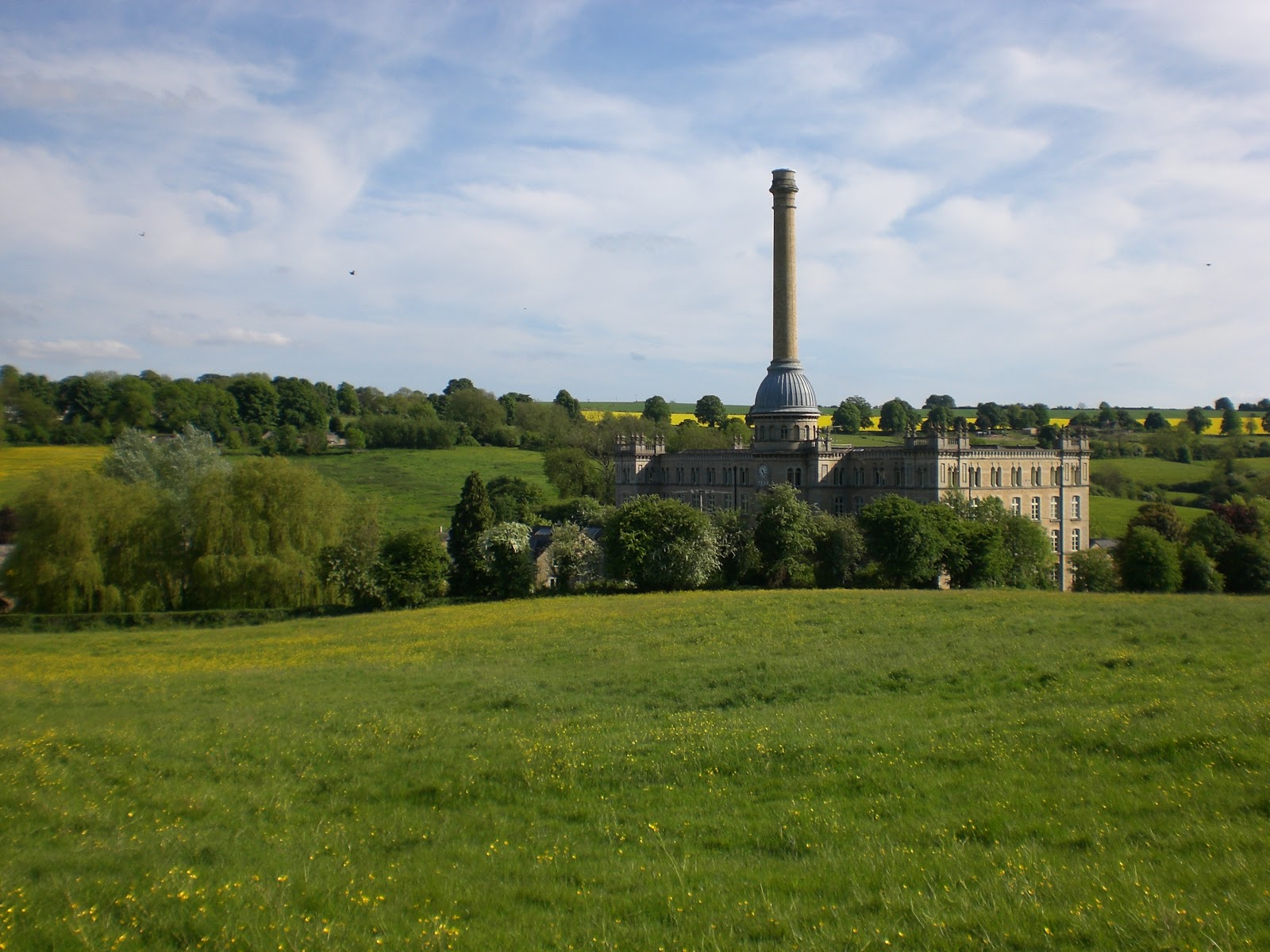
It particularly spoke to me as it conjured up memories of one particularly idyllic mid-summer's day in 2009 when I took the picture below, as I lay in a meadow with my mum and The Cat, taking a wee break from a drive through Oxfordshire.


The reason we'd initially stopped was because I'd spotted this amazing building and wanted to see if we could get a proper look at it:


When I did my research upon getting home, I discovered it is called the Bliss Valley Tweed Mill... Perfect, no?

Here's to art, photographs and treasured memories that keep summertime bliss alive all year round.

Wednesday, 1 August 2012

Love Letter Featured, and a Chop House


Recently, a lovely lady from a website called Be In Style contacted me to say she wanted to feature Love Letter from London in their weekly series which hand-picks style blogs of interest from around the internet. You can read the feature here, which focuses on vintage and crafty style blogs, and which also happens to include one of my regular reads, Molly-Made.

For the article, I was asked to pick a picture which encapsulated Love Letter from London - which was a lot harder than I anticipated! I wanted to include my two main interests and usual focus of my blog - vintage style and historic architecture... but no one, individual picture captured both those things. After I'd looked through lots of pictures and rejected them all, I ended up popping out to grab some photos of one of my favourite local (and very London) buildings, with myself stood in front, in what I happened to be wearing one Sunday.

After emailing the above photo off to Be In Style for their feature, I thought I may as well turn the pics into a blog post! This was a casual Sunday outfit for a trip to the National Portrait Gallery to see the very satisfying Annual Portrait Award. (Recommended by me! And free!)

Top: Beyond Retro
Trousers: Off-cast from a friend
Shoes: Jones Bootmaker
Handbag: Beyond Retro
Earrings: Boutique shop (of which the actual name escapes me as it was many moons ago...)

The building has been glimpsed in a very early blog post. Located on Farringdon Road, near Rosebery Avenue, it's a late Victorian building, which was converted to a working class restaurant in the very early twentieth century, a place where someone could get a good, hearty meal for a reasonable price.


Alongside its fellow Victorian neighhbours

"London's noted cup of tea"

"Quick service" - important for working lads and men

"Civility" - as should be expected

"Progressive working class caterer"

"Jellied eels" - a familiar working class London food

... and less expected - "Caviar"!

The interiors are amazingly well preserved with fixed benches and tables, timber panelling and decorative pressed tin wall coverings (known as "steleorite"). The wonderful state of preservation of the original fittings and fixtures is one of the reasons this quirky piece of social history has been designated as a Grade II listed building. Sadly, it is presently closed, so this historic picture of the interior is all I can provide at present:

A festive, historic photo of the Quality Chop House (Image source)

Next time (or at some time in the future): the equally lovely Edwardian fire station opposite the Quality Chop House, as glimpsed in the glass reflections of the above photos. I just have to see if the firemen will agree to posing for some pictures for me...