Smithfield Market before the buildings, 1855, in the Illustrated London News (Image source)
I really want to sit down and do a proper blog post as I do have several things up my sleeve. Unfortunately I've found myself terribly busy over the past month as I'm starting a new job! This means I have lots of things I'm having to get organised and finished, inside and outside of work hours, and I'm quickly running out of time...
I intentionally make sure to be quite obtuse about the specifics of my work on this blog, to keep things separate and to make sure that I don't step on the toes of professionalism, confidentially and all that. Though I can say that I am rather sad to be leaving my current job in Smithfield, where I have been based for over six years... But I am also terribly excited to be taking up my new job in Westminster, where I will now be based.
So, from offices in the historic City of London - the heart of England's commerce - to offices in the historic City of Westminster - the heart of England's parliament. What new streets and treasures will I discover on my lunchtime strolls, I wonder?
Westminster from the River, 1792, by Samuel Ireland (Image source)
I was doing some reading up on the history of Lake Shore Drive in Chicago and came across this picture, which I thought I'd share with my readers on this Easter Monday. Mr and Mrs John Barnes, strolling down Lake Shore Drive with their dog, Dandy, on Easter Sunday, 1932.
This is rather a special post, even if I do say so myself... Something both inspiring and full of glamour for the first day of the working week.
The background story is that my mother is friends with an amazing lady named Thelma, who lives just down the street in their town. Back in the 1930s and 1940s, she worked for the art department of Hoyts, a big cinema chain in Australia. Her job was to watch the new films and then visit the different cinemas to paint a relevant and inviting picture to entice the audiences in.
Recently, when my mother went to visit, Thelma pulled out some of her old sketch books, filled with her wonderful drawings. My mother was thrilled and asked if she could take photographs of them, which she then shared with me. Equally thrilled, I asked if I could share them with my readers on my blog, to which Thelma gave her blessing.
See if you can spot some of the glamorous stars from Hollywood's golden era:
I'm sure Thelma didn't always see her job as particularly glamorous, when she was rushing from cinema to cinema to meet deadlines and covered in paint, with aching arms and back. But to me, it's like the next best thing to my mother being friends with a Hollywood starlet from the period. And when you think about what other young women were doing at that time, if they were even working at all and not stuck at home while the men went out to earn a living, it is pretty damn awesome and inspiring.
I'm on holidays! I can't begin to tell you how excited I am to have started my first proper, week-(plus-)long break from work in 10 whole months! And it's jam-packed full of fun and variety too.
I'm off to west-coast Ireland tomorrow for three nights...
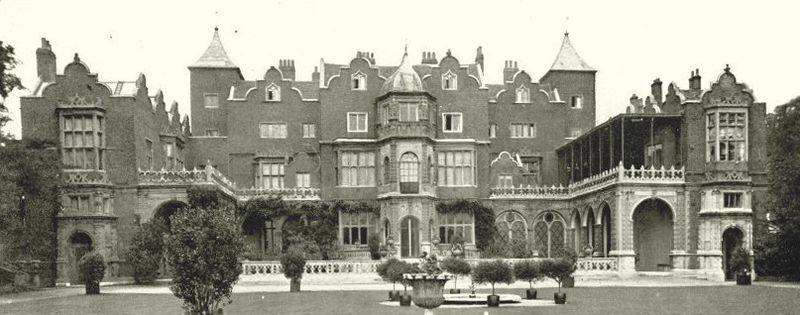
Some time ago I was doing some research about Holland Park. In the course of reading up on its history and development, I came across a series of Earls of the British peerage with possibly the most fabulous surname ever: Fox-Strangeways.
Okay, actually, technically, officially, it's Fox-Strangways but in my mind I inserted an "e" because... well... it just transforms it from being pretty awesome into entirely marvellous.
Here's one of them, Henry ol' chap, 5th Earl of Ilchester, as caricatured in Vanity Fair:
Henry Fox-Strangways in Vanity Fair, 1882 (Image source)
And where do you think these Fox-Strangways folk lived? Well, right here, of course:
I am now contemplating changing my surname to Fox-Strangeways. I wonder if there's a dashing Fox-Strangways bachelor still out there, carrying on the family name? If so, I could marry him and then "accidentally" slip in a convenient "e" when I fill out the official forms to change my name. Alternatively, I could just have my name changed by deed poll anyway, but that might seem a little bit... affected.
In the meantime, I've decided to set myself to drawing a character of my own creation called Lord Fox-Strangeways. I'm not sure if he's going to be human or vulpes yet... I might let you know how I get on, depending on how he turns out.
In a couple of hours, I'll be at Euston Station, preparing to depart on the sleeper train up to one of the UK's best cities...
No, I'm not starting my Christmas holidays early. I'm actually heading up to Scotland on a work assignment, to hopefully uncover lots of archival treasures and solve architectural mysteries...
One of the useful sources for researching a particular type of building (big, old, grand country houses and castles, namely) is Country Life magazine. It's been published since 1897 and every issue is on the shelves at the wonderful RIBA Library in Portland Place.
Whenever I'm looking up an architectural article in Country Life, I always have to flip back to check out the "Page Three Girl", as I like to refer to them (or otherwise sometimes referred to as the "Girls in Pearls"). Every issue has a society lady on the frontispiece, often when she is getting married or engaged or coming out (in the debutante sense of the phrase, naturally...). The whole thing just makes me chuckle, but is also a great record of changing fashions and styles.
April 10, 1942: The Hon. Mrs. Ronald Strutt The wife of Captain the Hon. Ronald Strutt, Coldstream Guards, the elder son of Lord Belper and the Countess of Rosebery, is the younger daughter of the late Sir Harry Stapleton Mainwaring and Lady Mainwaring, and before her marriage nursed with the Red Cross. Captain and Mrs. Strutt have a little son, born last year.
When I was at the RIBA one weekend months and months ago, researching my thesis, I took copies of a few of the ladies to share on here. In addition to looking in the volumes I had out for my research, I wanted to go right back to the start to see where it all began. I discovered that the first few issues actually had male Heads of State and royalty and such like. Obviously, this didn't titillate the readers enough, so they were quickly substituted for our first society ladies making an appearance.
March 6, 1897: Lady Terence Blackwood
Almost 60 years later, the gown is nearly as resplendent, but the neck is devoid of jewels, the hair cut short, the hands gloveless and the woman unmarried. Tut, tut...
October 6, 1955: Miss Priscilla Gurney Miss Priscilla Gurney is the eldest daughter of Mr. and Mrs. John Gurney, of Walsingham Abbey,Norfolk
But what have we here? As I cropped the image of the lovely lady below for posting, I noticed the name of the photographer in the bottom corner. Yes, it's none other than Madam Yevonde, about whom I wrote a post last year. So, after the decadence of dressing 1930s society ladies as Greek goddesses, she undertook the tame pursuit of photographing demure young women for Country Life magazine. I wonder what Miss Bridgeman would have looked like dressed as an Amazonian Queen or Medusa...
August 18, 1955: Miss Tessa Bridgeman Miss Tessa Bridgeman is a daughter of Hon, Maurice and Mrs. Bridgeman of Milhanger, Thursley, Surrey, and a niece of Viscount Bridgeman
One day, I would love to spend hours just leafing through back issues of Country Life and looking at all the Page Three Girls. I wonder when we first saw a skirt above the knee? Or trousers? Or when we first found out the woman's university qualifications? Or when they started having "male" jobs? I can't help but think that some delay was experienced before most benchmarks of female emancipation found their way into the pages of Country Life.
In fact, it would be quite fascinating to trace the development of the Girls in Pearls. And I can think of worse places than the beautiful, timber-finished 1930s library of the RIBA to spend a wintery Saturday. Perhaps I will be back with more ladies for you shortly...
Following up on the travel theme of my last post, and just for a bit of fun...
Air hostesses. What I also want to know is why they don't make them like this as standard anymore?
All images are from The Retroscape website. If you don't subscribe to it, you really, really should. It is full of amazing images like this, from all different eras.
And thinking of sassy ladies and planes brought my mind to James Bond and Pussy Galore's Flying Circus girls. Which is also relevant as The Cat and I are finally going off to see the Designing 007 exhibition at the Barbican tomorrow. We have pre-ordered our tickets, and our martinis. Very excited!
Pussy Galore and her Flying Circus girls (Image source)
I know lots of people hate losing that hour of light at the end of the day but I love it. I think it's entirely Romantic (with a capital "R", that is, in the vein of the Romantic movement). I love being out as the sky darkens early, whilst shops and cafes and museums remain open, with warm, glowing light pouring through their windows, and people still hustling and bustling about.
Mackay Hugh Baillie Scott clock, 1900-1905 (Source: V&A)
I love the weather - brisk and cold, perhaps with some weak sun, perhaps with a bit of drizzle, but always encouraging you to pull your coat around you and breathe in the cold air. It's invigorating and exciting. Winter is on its way and we're in for short days and long, cosy nights. I do love the deepness of the darkest winter months that are rapidly drawing nearer.
It bothers me immensely that the government are talking about having British Summer Time hours in winter and "double summer" in the middle of the year. For one thing, it doesn't mean we'll have any more light, it just means that the mornings will stay darker even later, making it especially hard to get out of bed. I don't mind the sun setting early but dark mornings are a challenge!
Clock of unknown maker, Staffordshire, c.1760-1780 (Source: V&A)
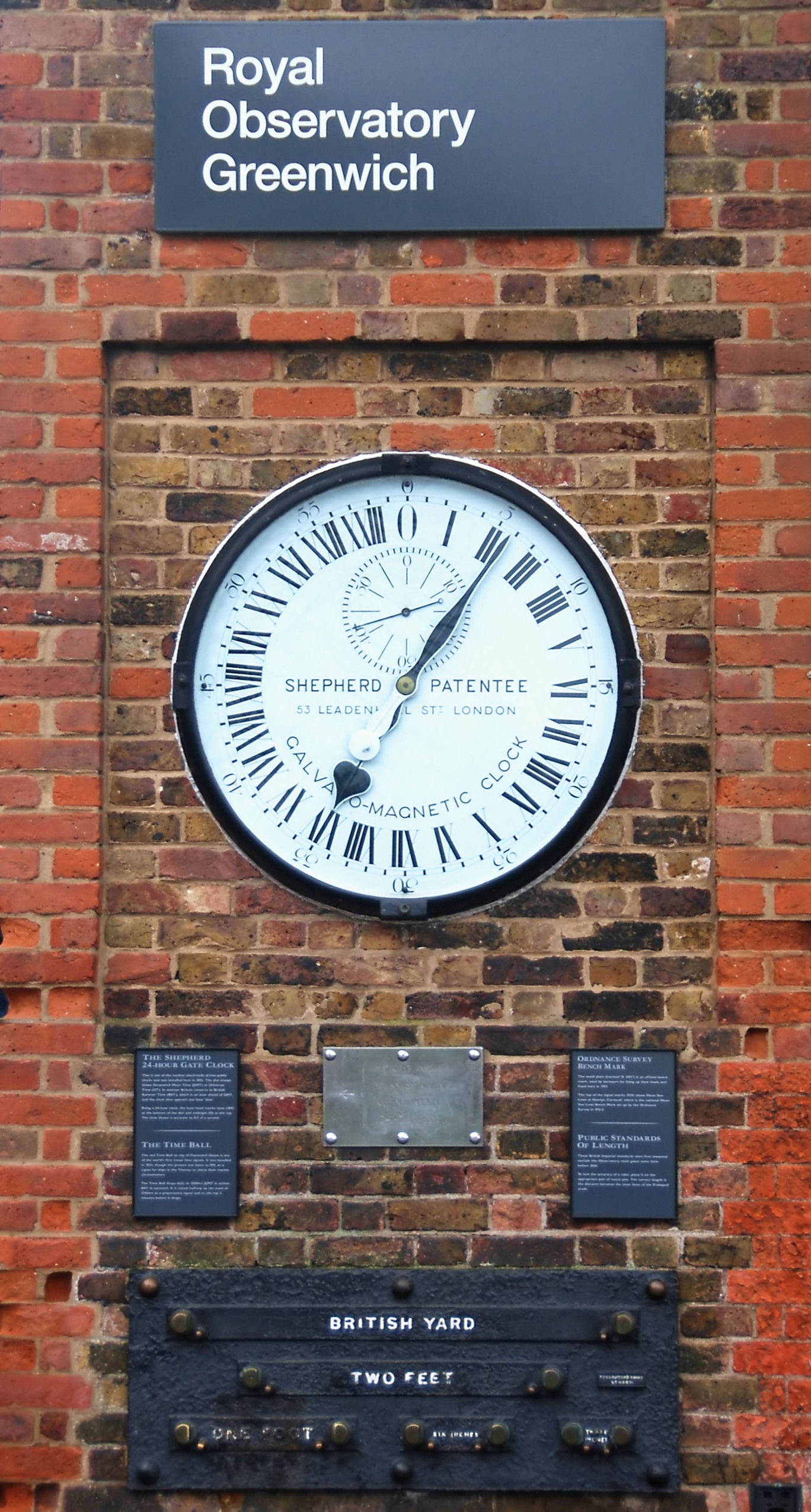
Secondly, I think it's an absolute travesty that we will never be on Greenwich Mean Time! As an historian, that really bothers me. It has its roots in our proud maritime history, with ships being able to calculate their longitude using GMT, therefore being vital to navigation. Its history also embraces another era of great significance - the Industrial Age - when the railways were laid out across Britain. This was when the whole nation adopted GMT as it allowed more sense to be made of railway timetables. Prior to this, each area had its own local time.
The changing of the clocks isn't that old a practice, only having been introduced in 1916 during the First World War, partly as a measure to save on coal. The thought was that if the evenings were lighter for longer, less fuel would be needed for lighting. It's stuck ever since then but, as part of this current, silly debate about GMT, British Summer Time, and Double Summer Time some people are mooting for the tradition to be abolished, so that we are permanently on Summer Time - in line with the rest of Europe.
Anyway, enough of that silliness. I, for one, hope that it stays the same so that we don't lose the small delight of the changing clocks each autumn and spring. But for the moment, I'll just enjoy the rest of my long evening on this, the first back in GMT. Think it's time for a glass of wine and a bit of classic horror in honour of Halloween tomorrow. If only I had some chestnuts on hand to roast and tuck into as I watched...
I was considering going to the Museum of Childhood today and I found this lovely item from their collection when I went on their website. Thought I'd quickly share it with you.
As part of a current work project, I've been spending lots of days at the Imperial War Museum recently. Considering how highly I regard the museum and its collection, I must say I'm feeling pretty chuffed about getting to work on it. It's been quite a challenge to not get distracted by the exhibits though... And the shop... But I've been pretty good, just buying a couple of postcards to add to the little collection of pictures which adorn my desk at work.
I'd already had this poster up for a while, long before starting on this current job:
Now I've added these two:
The one below wasn't available as a postcard or poster... So I have to confess I ended up buying a whole little book of British wartime posters in which it features. It never actually got used as a recruitment poster because it was considered to be too risque - the blonde bombshell, it was nicknamed - but ain't it just fab?
All that aside, one of the definite perks of my job is getting to climb onto the roofs of all sorts of buildings. Here's the view from the top of the museum, down into the central exhibition space... except I then realised you could get the same view from the top balcony inside the building, which is accessible to all visitors. Plus, I caught my own reflection in the glass. Oh well...
Last weekend I went to the Museum of 51 at Royal Festival Hall, which is part of the 60th anniversary celebrations for the Festival of Britain. Oooh, it was wonderful! I recommend that everyone who can get there does so before it closes at the beginning of September. It won't even cost you a penny - it's absolutely free!
I can't share pictures of the exhibits with you because I was sans camera but I can share this video which I watched with delight and was terribly pleased to find available on YouTube when I got home. It's fairly long but if you're interested in mid-century architecture, design and spacial planning, then you should absolutely set aside some time to watch it. Even if you're not, it's got that wonderful 1950s documentary style that just makes everything seem quaint and fascinating.
After the film finished, I pulled out a notebook to jot down some of the most interesting points from the video (yes, I'm like that) - the British not liking rhetoric in their buildings and the festival site's embracing of intimate rather than grand spaces; the subtle methods used to distinguish but also connect spaces in the festival buildings; the surprise and interest created by levels and textures and corners; landscapes coming into buildings and buildings projecting over landscapes; platforms over the Thames to connect Londoners back to the river, etc, etc.
As I wrote desperately, trying to remember all the key points that had grabbed me, the chap who had been sat near me during the film approached me and asked if I had dressed up in 1950s style to come to the exhibition. Stunned for a second (partly because my ensemble was really more 1940s...), I responded with something along the lines, "Um. Oh! I guess... Well, I just wear this kind of thing most of the time." He was pleasantly intrigued by this and said something nice about my outfit and then walked off to let me finish my note-taking. I like it when people are pleasantly intrigued by my style and politely ask about it but I never know what to say! I need to come up with a simpler response to the garbled ones I usually give... When someone asks of my outfit "Is that 1950s?" and they're some older chap, I have to remember that they probably aren't interrogating me about whether my dress is of genuine vintage but are rather just curious and asking about the overall look and inspiration!
But enough of me and back to the exhibition. Just to sell it further, there was wonderful memorabilia to examine, including - possibly my favourite - little cards which said "Festival of Britain visitor" (or some such) with a space to insert your photo. Oh, how I would love one of those! There were architectural drawings for the buildings and site, sketch designs for the logo, a replica 1950s room where you could lounge on a sofa and flip through a scrap book of newspaper cuttings with period music playing (though, unfortunately, I quickly learnt as I sat there reading newspaper cuttings that it was just the one song on repeat), an old typewriter where you could type your telegramme (see above), guidelines for the unifying festival font, pretty printed silk scarfs, and lots more!
The final delightful thing to mention is the wonderful Patchwork of the Century.
This covers the hundred years from the Great Exhibition of 1851 through to the Festival of Britain in 1951 and was made by a group of women with no prior experience of needlework, led by one Lilian Dring. It was created from scraps of material such as uniforms and blackout curtains left over from the war. There is a bit more information about it on this web page.
As I stood there examining it, trying to work out what each square represented (there is a "cheat sheet" for those not up to the challenge, or for when you give up), I thought what fun it would be to create a patchwork from 1951 to 2011! What would I choose for each square? What event or person defined Britain in each of those 60 years. I wondered idly if I could convince any fellow bloggers to join me on a quest to gather a large enough group of keen amateurs to tackle 60 patchwork squares... Just idly wondering...
I came across this wonderful drawing whilst doing some archive research the other day:
It shows the grounds of a villa near Crystal Palace Park in Sydenham, and it wasn't relevant to what I was looking for but I snapped a shot as it captured my fancy. I'm really getting into historic gardens lately and I thought this layout was just fabulous.
My knowledge of garden and landscape history isn't so hot (yet!) but this was a late 19th century drawing and I think the trend around then was for picturesque, "natural" (but in reality, completely contrived) landscapes. There's a bit of formality closer to the house here:
But overall, there's not much formal symmetry or straight lines in this garden. Check out that scrolled path at the bottom!
Oh, the thought of traipsing about in that garden just makes my toes tingle with excitement! Meandering along the serpentine paths, ducking into the wooded borders for games of hide and seek...
And I wonder what those open lawns might have been used for? Garden parties? Croquet? Sigh!