Showing posts with label art galleries. Show all posts

Tuesday, 19 November 2013

Halfway Down the Stairs

The Tate Britain re-opened in its full glory today, following a massive refurbishment. Apparently one of the highlights is the new staircase:

Tate Britain, Millbank, London (Image source)

And don't we, as a species, just love a good staircase?

Wells Cathedral, Somerset (Image source)

Tulip Staircase, Queen's House, Greenwich (Image source)

Nelson Stair, Somerset House, Westminster (Image source: David Holt London)

Tassel House, Brussels (Image source)

De la Warr Pavilion, Bexhill-on-Sea, Sussex (Image source) 

What is it about staircases that we find so appealing? Is it simply the graceful sweeping form of a curved stair, and the pleasing angles and geometry of those that are square on plan? Or is the sense of anticipation in not knowing what lies around the next bend or on the next landing? Or is it the underlying feeling of wonder for the mathematics and physics that appeals to us on some subconscious level, even if we aren't engineers? Or it it that slight sense of exhilaration in being able to move across planes and spaces in ways that would not be possible, were it not for these structures?

Whatever the case, I certainly think there is something more profound than pure aesthetics that gives us a sense of awe and great pleasure on encountering a particularly noteworthy, or even a relatively average staircase.

M.C. Escher's Relativity (Image source)

And that, my dear readers, is what I call a tangent - from a gallery re-opening to waxing philosophical about staircases. Though I did manage to draw it back to art with Escher there.

But do pitch in, what is your favourite staircase? Is it a simple stone medieval spiral staircase? A sweeping marble Baroque palace staircase, with ornate gilded balusters? A clean white, sleekly formed Modernist staircase? Or is it something more humble, like your carpeted, timber staircase at home?

With that last thought, let me leave you with an old favourite poem, which might indeed say a little more about the simple appeal of staircases:


Halfway Down
(A.A. Milne)

Halfway down the stairs
is a stair
where I sit.
There isn't any 
other stair
quite like 
it.
I'm not at the bottom,
I'm not at the top;
so this is the stair
where 
I always stop.

Halfway up the stairs
isn't up
and it isn't down.
It isn't in the nursery,
it isn't in town.
And all sorts of funny thoughts
run round my head.
It isn't really
anywhere!
It's somewhere else
instead!

Saturday, 28 September 2013

Random Reasons to Love London #11

Whistler's Nocturne: Blue and Silver - Chelsea, 1871 (Image source: Tate)

Last weekend, I was feeling a bit run down so decided to spend a gentle afternoon in the Tate Britain. As I wandered through the permanent collection, I stopped to look at the above Whistler painting, which they have on display. A woman who also stopped to examine it asked me if I knew if we were allowed to take photographs. I said that I thought so, if you didn't use a flash (apologies to the Tate is this was misinformation!).

We carried on our conversation and she told me that she was very excited to see the painting in person as she was president of Whistler House - the birthplace of James McNeill Whistler - in Masschusetts. We then went on to talking about the various artists' residences around Chelsea, here in London, and her plans to go on a walk and see some of them. She was quite impressed by my knowledge of the topic - which has come from a combination of volunteering at the wonderful Carlyle's House for some time a few years ago and recent work advising on listed artists' studio flats in the area... and supplemented by general interest in the period and its people as well. 

Perhaps I ought to do a post on the topic one day. (Did you know, for example, that Dante Gabriel Rossetti had a whole collection of exotic animals at his house on Cheyne Walk, including a wombat?)  But, whether that eventuates or not, it made an enjoyable and stimulating interlude to my afternoon, speaking with this interesting and interested lady at the Tate. Art galleries really are a great place for good conversation with random strangers.

Rossetti's sketch of himself mourning his wombat, Top (Image source: Pre-Raphernalia)

Sunday, 7 April 2013

Love Letter to an Artist #3

Last weekend, I went to the current Manet exhibition at the Royal Academy. To be honest, I had been prepared to let this one pass me by. Though I do like Impressionism, I can't say that I have ever been particularly drawn in by Manet. I suppose that I haven't been exposed to that much of his work in the flesh and none of his most reproduced and lauded paintings have really spoken to me. In addition, the focus of the exhibition was portraiture and, unless it's the work of an artist I particularly love, I am generally less inclined towards straight portraiture than other subjects.

However, I was enticed into going by one of my friends, as his enthusiasm made me think again about my readiness to dismiss the exhibition. And I am so glad I allowed myself to be enticed because it was truly wonderful. It encouraged me to do some reassessment, it amused and surprised me, it presented some revelations and impressed me with its variety. It helped me to place Manet within the course of art history, particularly with regard to the hints of modernist techniques and style in his paintings. And, always a sign of a good exhibition, I was just stunned and overwhelmed by the beauty of it all.

One of the paintings which particularly captured my fancy was The Amazon:

Manet's The Amazon, c.1882 (Image source: Wikimedia Commons)

The painting shows a young female horse rider and I just thought her wonderful. Her androgyny particularly appealed to me - she could almost be a beautiful young man. Someone else might see it differently but, to me, it's rather an empowering female portrait. She feels very modern, she's dressed for action (perhaps it helps that she is cut off just below her waist, so you can't see the ridiculously impractical skirt she was probably wearing...). She looks like she knows what she's doing and you can imagine this young lady keeping up with the boys. And this all made me rather fond of her.

So, sure, I might let Manet paint me, if de Lempicka and Burne-Jones weren't available.

I'll leave you with a couple of more favourites from the exhibition.

In the Garden, 1870 (Image source: WikiPaintings)

Berthe Morisot, 1870-71 (Image source)

Sunday, 17 March 2013

Bliss Valley Daze

A couple of weeks ago, I was up in Sheffield and visited their Millennium Gallery. The gallery is currently showing a landscape exhibition and one of the works on display which particularly captured my fancy was a continuous animation by Julian Opie. I thought I'd share it on my blog as those of us in the northern hemisphere begin to anticipate spring. 


You can indulge a little here, although it's only part of the full animation. Granted, nothing much more happens in the full version, but the plane does make it across the sky and another crosses in the opposite direction, making for an even more soothing and hypnotic experience...

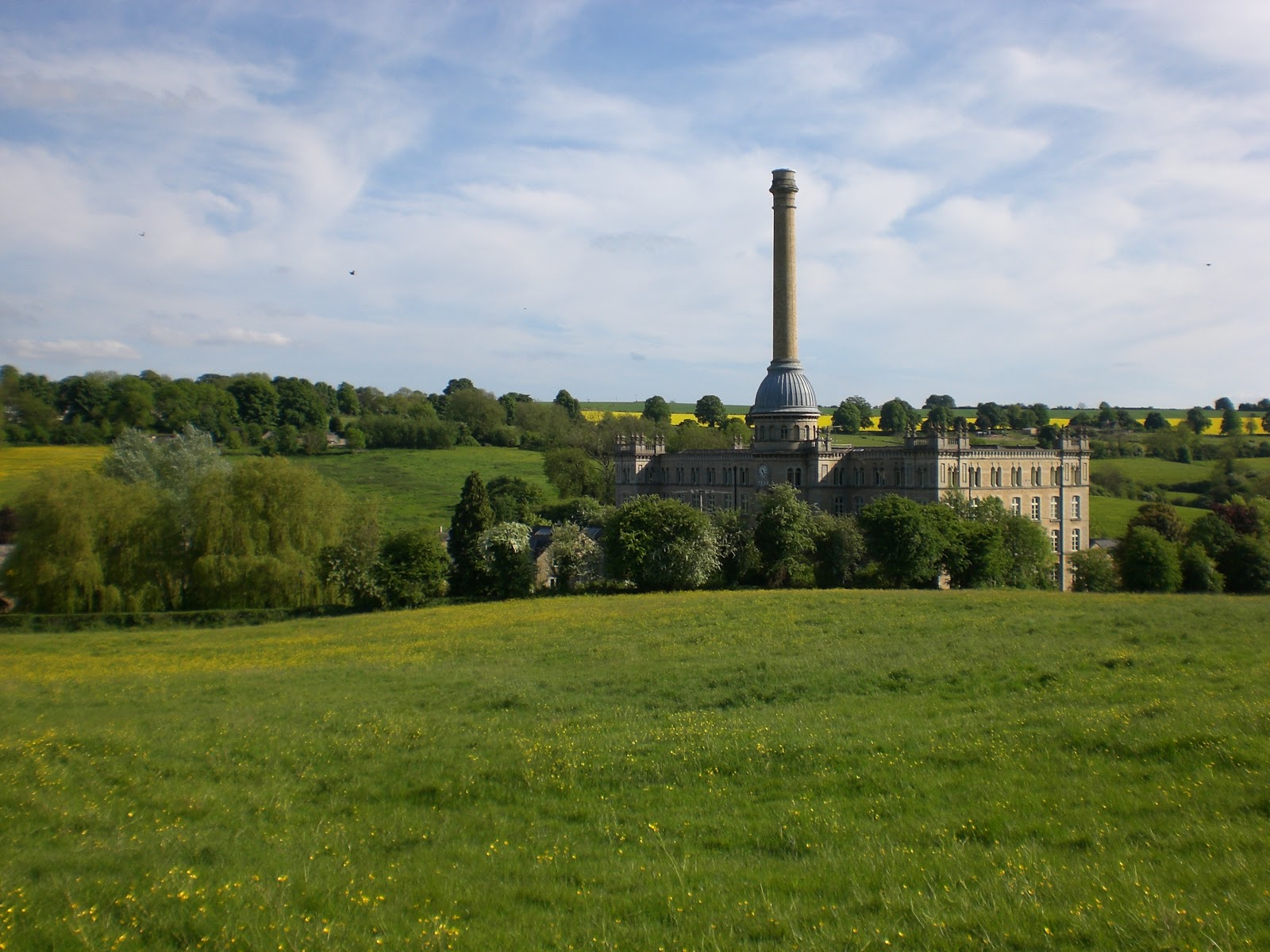
It particularly spoke to me as it conjured up memories of one particularly idyllic mid-summer's day in 2009 when I took the picture below, as I lay in a meadow with my mum and The Cat, taking a wee break from a drive through Oxfordshire.


The reason we'd initially stopped was because I'd spotted this amazing building and wanted to see if we could get a proper look at it:


When I did my research upon getting home, I discovered it is called the Bliss Valley Tweed Mill... Perfect, no?

Here's to art, photographs and treasured memories that keep summertime bliss alive all year round.

Monday, 4 February 2013

Coming Soon to a Gallery Near You...

 I just found out about this exhibition which is about to open at the National Portrait Gallery...


Well, that'll certainly be a worthy distraction as I expectantly wait for this to open at the Tate Modern later in February... 


And then I still have this to look forward to the following month...


Oh, London, you know just how to treat a girl, don't you? Indulging me with all this wonderful 20th-Century art and design...

Keep an eye out for posts about all of the above over the coming months!

Monday, 14 January 2013

A Photographer or Two's Eye on the City

Last Friday night, I went along with a friend to see the photography exhibition currently showing at the Tate Modern, which brings together the work of the American William Klein and Japanese Daido Moriyama. I have to confess to not having known of either of them prior to this visit (though some of Klein's work seemed vaguely familiar) but I'm so glad I went along because the exhibition was fantastic and I made some new discoveries.

It was off to a good start with a room screening a short film called Broadway by Light, which was a 1950s spectacular celebrating New York's neon signage. I love the pop artness of old school neon...

Screen shot from Klein's Broadway by Light (Image source)

In the next room, my friend and I both fell in love with, and stood momentarily mesmerised by this picture:

Evelyn, Isabella, Nina and Mirrors, for Vogue (Image source)

Isn't it wonderful? I absolutely love the composition of it, the backdrop, everything...

Like England's own David Bailey and Norman Parkinson, William Klein was breaking convention in the 1950s/1960s by taking his fashion models out of the safety of the studio and into edgy, urban settings.

We then watched a fascinating video in which the photographer himself talked through the process of selecting one photo over another, and what makes a photo work.

Mai 1968, Paris (Image source)

The selection process turned into an art form itself, as Klein found that marking up contact sheets with red pencil wasn't clear enough and that enamel paint was much more effective...

Painted contact sheet (Image source)

The exhibition also explored Klein's abstract art beginnings and his transition into photography.

Vertical Diamonds (Image source)

Dorothy blowing smoke rings (Image source)

This was also the section in which I learnt that Mondrian, famous for his contribution to the De Stijl movement, with his primary colour blocking, geometric paintings, began life painting rural scenes... I've still so much to learn about art... But that's rather an invigorating and exciting thought, knowing that there's endless things to discover. I got home and looked up Mondrian's early work on the interwebs and sure enough:

One of Mondrian's earlier works (Image source)

The exhibition then segued into Moriyama's work. Generally, I preferred the section on Klein but the Moriyama half also had a lot to offer. 

Hippie Crime by Moriyama (Image source)

Although, much of his work centred on people, snapped in street scenes, he also concentrated a lot on objects, spotting and focusing in on minor details in the environment (both urban and natural) to create wonderfully textured, almost abstract photographs, picking up lines and light and shadow.

I couldn't help but think how overwhelming the beauty of the world must be if you are constantly looking at it in the way he must be doing, in order to spot so many gem-like, rich details. I sometimes engage in the world on that level and it makes me feel like my head might explode, wanting to absorb and retain all the beauty and detail. To constantly be engaged like that must be wonderful but exhausting!

Not seen in the exhibition but I couldn't resist... Echos of Gatsby, and the eyes of Doctor T. J. Eckleburg, anyone?
(Image source)

My favourite part of the Moriyama section was a room covered in polaroids, which made up a scene of a room interior, shot piece by piece and panelled together. I can't quite explain it, nor can I find a good picture of it to share with you. You'll just have to believe me that it had a wonderful effect.

We finished up the exhibition watching short films in which each of the photographers was interviewed. In the film on Moriyama, he talked about how he loves the intensity of the city and the whirl of humanity, that he is addicted to the city and couldn't photograph without it. Reading about fellow blogger, Kelly-Marie's recent relocation to the seaside, where she quoted a beautiful extract from Anais Nin, made me momentarily resent the city... but this exhibition reminded me again why I adore it and thrive on it.

Wednesday, 14 November 2012

Love Letter to an Artist #2

Last year, I dedicated a love letter to Tamara de Lempicka. Having been to the Pre-Raphaelites exhibition at the Tate Britain twice recently, I feel compelled to follow this up with another love letter to an artist, this time to Edward Burne-Jones.

The incomplete Tristram and Iseult, abandoned by Edward Burne-Jones in 1872 (Image source)

His works were stand outs for me in an utterly wonderful exhibition. Until this, I had really only been familiar with his work as a stained glass artist (such as the windows seen in my recent post). His paintings were a revelation though. They were so incredibly beautiful, I felt rather emotional and overwhelmed. I was entranced by their exquisite detail and wonderfully rich colours.

Love Among the Ruins, Edward Burne-Jones, 1894 (Image source)

I think the Burne-Jones paintings particularly stood out because they felt, stylistically, like a breath of fresh air at their first appearance more than halfway into the exhibition. By that point, the work of some of the prevalent artists who had been with us from the beginning had begun to feel slightly hazy around the edges, too familiar and safe and sentimental. Even though Burne-Jones's most striking paintings didn't come until the last room, the appearance of his first painting caught the eye with its distinct palette and lines, which felt somehow different and bolder.

Georgiana Burne Jones, Edward Burne-Jones, 1884 (Image source)

To me, Burne-Jones seems to be heralding the beginning of Art Noveau with his figures and with the delicate and exquisite facial features of his subjects, verging towards an angularity which Rossetti would not even dare consider. His ever so slightly sinister but compellingly beautiful paintings feel almost like a whisper of things to come, a prelude to artists such as Harry Clarke and Aubrey Beardsley.

The Rock of Doom, from the Perseus Cycle, Burne Jones, c.1885-8 (Image source)

But there was, of course, more to the exhibition than just Burne-Jones. The angle the Tate went for was to illustrate how the Pre-Raphaelites were avant garde in their time, young upstarts rebelling against the conventions that had come to dominate the Victorian art world, bringing "a new beauty and intensity of vision to British art". That they caused a stir amongst their contemporaries is easily forgotten when their famous works have been reproduced a million times over and feel so quintessentially English and polite today. (And, in fact, it is even disheartening looking at the reproductions I am including in this post, as they distinctly lack the punch of the originals, as details are lost and colours muted).

The Death of Chatterton, Henry Wallis, 1856 (Image source)

As happened in architecture, the Pre-Raphaelites turned back to medievalism in an age that was being overtaken by the ugliness and dehumanising effects of industrialisation. The flatness of their paintings, sharp outlines and bright colours harked back to the style of past ages, but they embraced more wide ranging subjects. So wide, in fact, that it is sometimes hard to grasp their purpose or understand them as a coherent movement. Given that the Pre-Raphaelites seem to be so innocuous and simple at first glance, they are somehow surprisingly hard to fathom...

An English Autumn Afternoon, Hampstead - Scenery in 1853, Ford Madox Brown, 1852-5 (Image source)

The exhibition commentary does pick up the main ideas of the movement though, how these flew in the face of convention and reacted to changes in society. It takes a vaguely chronological approach, beginning with the origins and then devoting the next few rooms to different themes. It traces the gradual move into the Aesthetic movement ("art for art's sake") including the appearance of Morris and his decorative arts, before finishing with the diverging paths of the Pre-Raphaelites in the last decades of the nineteenth century.

Autumn Leaves, John Everett Millais, 1856 (Image source)

What I found most interesting about the exhibition was actually identifying the different styles of the artists that come under the umbrella of the Pre-Raphaelites, and the different directions the individual artists went in over the course of their careers. Aside from the revelation of Burne-Jones's paintings, Millais was confirmed as a favourite - from his deservedly famous Ophelia with its tragic beauty and astounding level of detail, to the wild, wide, unpopulated Scottish landscape of Chill October, via the simple beauty and natural richness of an everyday scene such as Autumn Leaves.

Chill October, John Everett Millais, 1870 (Image source)

I also confirmed that I'm really not particularly a fan of Rossetti, though he sometimes surprises me, and I discovered that Holman Hunt leaves me cold and occasionally mildly disturbed by the almost grostesque visages of the characters in his strangely cartoonish, hyper-coloured paintings. Probably the only exception to this was the lovely Isabella and the Pot of Basil. 

Isabella and the Pot of Basil, William Holman Hunt, 1866-8 (Image source)

Overall, though, a wonderful exhibition. I've come out with a better grasp of my individual Pre-Raphaelite artists, and it is a marvellously indulgent and aesthetically satisfying way to spend several hours. 

Monday, 23 July 2012

Random Reasons to Love Love London #6

Tate Modern Turbine Gallery (Image source)

On Friday evening, I went to see the current Edvard Munch exhibition at the Tate Modern (more on that later, hopefully). As I was looking around, enjoying the rich and wonderful paintings, a young chap who had been looking at a painting nearby caught the attention of my friend and me, saying "excuse me, but isn't this painting just so cool. Sorry, I don't know much about art, this is the first exhibition I've ever been to..." To which we responded along the lines of "don't worry about that". "I just think it's great, isn't it?", he carried on, in delight. We agreed and admired the painting together before he happily made his way into the next room.

I was just so pleased and flattered that he had chosen to share his excitement and unpretentious enjoyment of the painting with us. I like to think it's because we looked friendly and unpretentious ourselves... It made me really very happy to share this stranger's joy at experiencing these paintings up close at his first ever exhibition. I still become exuberant when I see original art works (or even prints of my favourite pieces) so it's not that I needed reminding of what a wonderful experience it can be, but it was just rather special to have this stranger so unashamedly keen to share his appreciation of this painting with us.

Sunday, 26 February 2012

The Cat's Pyjamas

As I mentioned last week, on Friday I got gussied up and went out for a nice blend of culture and fun at the Guildhall Art Gallery's 1920s-themed night. This is what I cobbled together from my existing wardrobe, for a vaguely appropriate look.

Dress: Rokit
Slip: M&S
Shoes: Jones Bootmaker
Sash: Bit of ribbon from a local haberdashers
Stockings: Boots
Brooch (worn on sash): Pierre Bex from Ebay (as written about here)
Earrings: Gift from my mum


But really, the look would have been nothing without the hair...


I'm really pleased at how well this turned out!  I think I ought to play with that style more often, especially until I get my fringe trimmed (which is becoming increasingly urgent if I don't want to be blinded, either temporarily by the curtain that is increasingly lowering, or permanently by being spiked with sharp hairs at the perfect length for painfully poking my eyes...). But this was actually dead simple for me, with my curly hair (God bless my curly hair).  The front just required a bit of coaxing and setting with pins as it dried.  One I removed the pins, the curls around my forehead stayed put without assistance and I just needed to pin the longer strands in place as a curl over my ear.  Everything else went into a Gibson roll and, voila!

By the way, those rings are the ones that never leave my fingers,
except when I'm asleep. The Whitby Jet (on the right) was a 25th
birthday gift from my mum and the other used to be The Cat's.

And here's some shots outside the Guildhall just to prove that I did actually leave the house.

I'm out of the house for something other than work!  And it's so mild that I have my coat casually open!

I would take outfit posts outside more often, finding interesting backdrops, but I never like having to remember to take photos when I'd rather be abandoning myself to fun.  Also, there's that awkward thing of being pose-y when there's random strangers about...  But, here, we found a relatively quiet spot on the opposite side of the courtyard from the Art Gallery.

Twirling about in the Guildhall complex, with its intriguing mix of old and post-war
buildings

Finally, we had a lovely night inside the gallery.  We perused the Age of Elegance exhibition, which was rather nice but which I wasn't blown away by.  There were some interesting and some pretty paintings in there but I felt that the theme didn't really come through that strongly, except in parts.  Baring in mind that all the pictures were drawn from their own collection, however, you couldn't really expect it to be as comprehensive or coherent as if they'd pin-pointed and borrowed from other collections.  So, it becomes more impressive when considered like that.

And, in fact, I'd like to go back to look at the rest of their collection when I'm not distracted by music, other entertainment and crowds.  It was difficult to focus purely on art with so much else going on!  There was a band in the main gallery with commendable stamina, playing classics and swing.  There were dance classes downstairs but I actually skipped that in favour of getting to look around the paintings at a leisurely pace.  But my highlight was potentially a chap called Mark Oostervan reading a P.G. Wodehouse short story, The Truth About George.  He was great, the story was a brilliant choice, and I was giggling away at all the best moments.

So!  The morals of this story are:
1) If you don't have authentic 1920s in your wardrobe, take the time to get the hairstyle right as that will work wonders in making your outfit more convincing.
2) Consider going to the Guildhall's Age of Elegance exhibition but don't break your neck in a rush to get there.
3) Take out a copy of P.G. Wodehouse's short stories from your local library and have a read.

Friday, 17 February 2012

Age of Elegance at the Guildhall

Next Friday, I am breaking my thesis-derived ban on fun to head to the Guildhall Art Gallery's late night opening for their new exhibition, The Age of Elegance. I spotted this ages ago when I was looking up information on their previous exhibition back in November or something, and it's been firmly in my diary since.  Try as I might, Friday nights are never productive anyway (as evidenced by the fact I'm blogging right now), so why not head out on the town?

The exhibition itself is a celebration of the fabulous years between 1890 and 1930.  So much happened between those decades in terms of style and social convention that at first it's kind of hard to see how it will all connect up.  But then when you think about the fin de siecle, Bohemian, wild abandon in the late Victorian era, and compare it to the interwar Jazz Age of Gatsby-esque decadence and luxury, I suppose there are currents which run through...  Something which I expect the exhibition will explore and which I look forward to seeing.

Lady Lavery by her husband, John Lavery
(Image source: Guildhall)

... And then there's the chance to have a little dance and a cocktail or two.  This special, late opening evening has been dubbed The Cat's Pyjamas and promises lots of entertainment in the Jazz Age vein, including a swing band and cocktail bar, as well as more quirky entertainment such as "spoken word cabaret".

Now, all I need to do is decide what to wear.  The temptation to wear 1920s, silky nightwear to play with the Cat's Pyjamas theme is great but I would have to source a new outfit for that.  Instead, I think I'll just have to go with what's in my wardrobe as I won't really have the chance to shop before then.  Unfortunately, my wardrobe doesn't particularly cover this period (love it, but the dresses never seen to suit my figure) but I'm sure I will manage to find something "inspired" by it...  Watch this space!

Saturday, 4 February 2012

The Queen: 60 Photos for 60 Years

Oh, yes!  The Diamond Jubilee joy starts here!  Windsor Castle is putting on an exhibition to celebrate this momentous occasion, which opens today.  It traces Queen Elizabeth II's reign through a series of sixty photographs (one for each year since 1952), showing both official occasions and more candid moments.

A young Queen Elizabeth II (Source)

Even if you aren't enamoured with the pomp of royal events, think of the vintage appeal that this exhibition will have, particularly in the early years of Betty's reign.  And, if we're lucky, there may even be some photos of her sassy baby sister, Margaret.

The more risque younger sister, Princess Margaret, Countess of Snowdon
(Source)

It's open until October this year, so there's plenty of time to get along and see it.  And if you can't make it, never fear, as I will report back in a blog post once I've been.  If there's an accompanying book, I may even be tempted to buy that... in which case, there could be some scanning and sharing of the best pics.

Sunday, 23 October 2011

All Dressed Up...

Today I went to catch the last day of the Glamour of the Gods exhibition at the National Portrait Gallery, which was a collection of Hollywood portraits from the 1920s to 1960s.

Whilst I was looking a picture of Marilyn Monroe, a lady came up to me and said, "You've obviously come from somewhere nice.  You're all dressed up".  To which I responded, blushing, "No, this is just my weekend wear", which she said was wonderful, making me blush further!  Unfortunately, I don't have an outfit photo for you to form your own opinions, but I was just in a full-skirted dress with bare back (It was hot in there!  I'd had to take off my jacket...), understated kitten heels and a bit of lipstick - quite a standard outfit for me.  Don't get me wrong though, I was flattered by her comments!

I do often have people surprised about what I wear on my "days off".  I don't know about everyone else, but I almost always dress more up than down on the weekends, no matter what I'm doing.  I have a bunch of dresses that I feel aren't quite right for the office which I relish wearing on the weekends.  They're not evening dresses, they're just perhaps a tad too... playful for the office.  That sounds a bit suspect but you know what I mean - full skirts and petticoats, strappy backs, that kind of thing.  Rather than showgirl outfits, which is what you might have thought with the "playful" description!

I guess I just don't understand the casual-on-the-weekend concept.  I take my non-work days as the chance to wear exactly what I want, and to experiment with hair and make-up as I don't have to be in a mad, morning rush.  I also find it's a good time to trial more quirky ensembles to see if I feel comfortable carrying them off in general public before unleashing them on my workplace.

I'd be curious to know, how does your weekend wardrobe compare to your weekday one?

Oh, and as I mentioned it, below are a few favourite pictures from the Glamour of the Gods exhibition.  Enjoy!  And hope you all have a good week, whatever you wear!

Louise Brooks by E.R. Richee (Source)

Carole Lombard by William Thomas (Source)

Michele Morgan by Ernest A Bachrach (Source)